
Our Founders
Monroe History
The People Behind Monroe’s Early Story
This page organizes two foundational historical interviews into an easier, more engaging format. Scan the highlights, explore a timeline, and open the full transcripts when you want the complete detail.
Quick highlights
What this story shows
- Early calculating machine innovation focused on visibility and proof of accuracy.
- Business adoption required education, demonstrations, and credibility.
- Monroe’s early growth was driven by quality manufacturing and expanding demand.
Why it matters today
- Accuracy, durability, and usability were core design priorities from the start.
- Monroe’s story is rooted in real workplace needs, not marketing language.
- The interviews preserve a primary source perspective on Monroe’s early development.
“I will buy your machine if you will instruct one of my clerks how to operate it.”
“We had long recognized an unfilled need in business for a figuring machine that would handle simply, directly, and with a minimum of mental and physical effort.”
An Interview with Mr. Baldwin
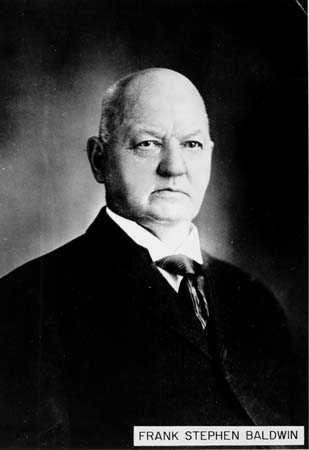
An inventor recounting early work that shaped the principles behind calculating machines used in business. Scan key moments first, then open the full transcript for the complete primary source detail.
What you will find in this interview
- Early education and experiments that led to invention work
- Key patents and machine concepts that influenced calculating machines
- Real world demonstrations, accuracy proof, and business adoption
- The connection to Jay R. Monroe and the early Monroe adding calculator
Moves to Nunda, New York. Early education and mathematics focus.
Enrolls at Union College. Family circumstances redirect him into business and invention work.
Accuracy proof and business value demonstrated through railroad auditing and table verification.
Recording calculator patent combining listing and calculation concepts.
Meets Jay R. Monroe. Collaboration begins toward an adding calculator adapted for modern business.
The following historical account is excerpted from “An Interview with the Father of the Calculating Machine,” Copyright, 1919, by Monroe Calculating Machine Co. and Copyright 1926, by Monroe Calculating Machine Co.
In the summer of 1840, when I was two years old, my family moved to Nunda, Livingston County, New York.
At Nunda, I attended the first free school instituted by the State of New York. Afterwards, I was graduated from the Nunda Institute, where I had specialized in mathematics. In a class competition, I surprised my teachers by memorizing the decimal of Pi to 128 places, and ever since that time I have been able to write it without effort.
In 1854, I was enrolled at Union College. My course was short lived, for soon after my entrance, father met with a serious accident, which crippled him for life and forced me to take over the management of his architectural business. I then began experimental work on several ideas. In 1855, I applied for a patent on an arrowhead self coupler for railroad cars. It was rejected on reference. This rejection only fired my ambition to succeed and perhaps determined my later course in the field of invention.
In 1860, business took me to Fort Wayne, Indiana. An uncle at Carlyle, Illinois, had designed a corn planter for which I assisted in securing a patent. This was a pioneer of machines of this class. Early in ’61, I went over to Carlyle to build the first model and arrange for the manufacture of the device.
The Civil War broke out and upset my plans. I enlisted in the Carlyle Home Guard, but stress of circumstances brought me back to Fort Wayne after the Three Months. So the war fever in me had to burn itself out in looking after the family.
In 1869, I went to St. Louis as manager of Peck’s Planning Mills. It was at this point I began to devote more and more time toward working out the ideas I had in mind.
Shortly thereafter, I invented and patented the Recording Lumber Measure, a machine which automatically measured and recorded four different kinds of lumber at the same time. This device set me thinking about computing machines and this point really marks the birth of the Monroe.
In the office of a life insurance company at St. Louis, I had seen the Thomas type of calculating machine, devised by C. X. Thomas of Colmar, France, about 1820.
Not until about 1880 did Mr. Burroughs start work on his own adding machine with a keyboard set up.
In October 1872, I married Mary K. Denniston of Williamsport, Pennsylvania. The year after, we moved to Philadelphia where I rented a small shop and started to make ten of the calculating machines.
I still have a copy of Mr. Taylor’s letter written to me from Philadelphia on August 8, 1874:
F.S. Baldwin, Esq.
Dear Sir:
I have used for the last four months one of your large machines daily in this department and have no hesitation in saying it performs its work rapidly and reliably, and for the purpose used does the work of at least three men with a certainty of correctness and greater rapidity.
Yours respectfully,
G.M. Taylor, P.R.R.Co.
In 1900, I patented the Baldwin Computing Engine, a machine by which multiplication or division was performed by one stroke for each digit.
In 1908, I was awarded a patent on the Baldwin Recording Calculator, which combined the listing machine with the calculator.
In 1911, I became acquainted with Mr. Jay R. Monroe, then associated with the Western Electric Company in New York City.
I showed him my machine. At once he saw its possibilities. We joined hands and set about designing the machine to make it as nearly perfect as possible in its adaptation to the needs of modern business.
Key dates timeline
Use this timeline to quickly navigate major points across both interviews. Select a card to jump to the relevant section.
An Interview with Jay Randolph Monroe
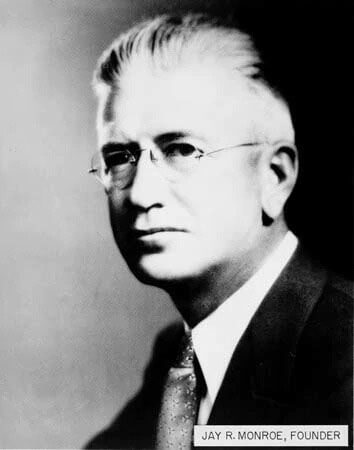
Monroe’s founder describes the demand for simpler, faster figuring with proven accuracy and the early growth of Monroe manufacturing, emphasizing quality, durability, and adoption.
What you will find in this interview
- Why business needed faster figuring with proof of accuracy
- How early Monroe development emphasized usability and durability
- How education, manufacturing quality, and expansion drove growth
- How Monroe became broadly represented in business operations
A machine that handles all four operations with minimal mental effort and proof of accuracy.
Durability, speed, simplicity of operation, visible proof, and a flexible keyboard.
Factory expansion and strict quality standards to meet demand.
Broader market representation as adoption grows.
Mr. Jay R. Monroe, President and Founder of the Monroe Calculating Machine Company, recognized the growing demands for simpler, faster figuring with proven accuracy.
“At the time we met,” said Mr. Monroe, “I had long recognized an unfilled need in business for a figuring machine that would handle simply, directly, and with a minimum of mental and physical effort, all of the four fundamental operations.”
Ours was a pioneering task. There was little precedent to guide us. In due time, patents were applied for and granted, and a new adding calculator, based upon an idea that had had its inception in 1870, was introduced to the business world.
We formed an organization and started the manufacture and sale of Monroe Adding Calculators. As the idea was new to business executives, educational work was necessary. Every installation meant a new Monroe friend.
In 1917, and again in 1920, new buildings were erected and the most modern machinery installed.
In 1925, we acquired considerable new property, installed new machinery and mapped out an expansion plan.
Source and context
The historical account on this page is excerpted from “An Interview with the Father of the Calculating Machine,” Copyright, 1919, by Monroe Calculating Machine Co. and Copyright 1926, by Monroe Calculating Machine Co. This page reorganizes the content for readability while keeping the transcripts available for readers who want the full primary source detail.